
Understanding Open Banking in Australia
What the Consumer Data Right is, how bank data sharing works, which kinds of apps use it, and how to evaluate connections — with official references and practical next steps.
Last updated: 25 Aug 2026
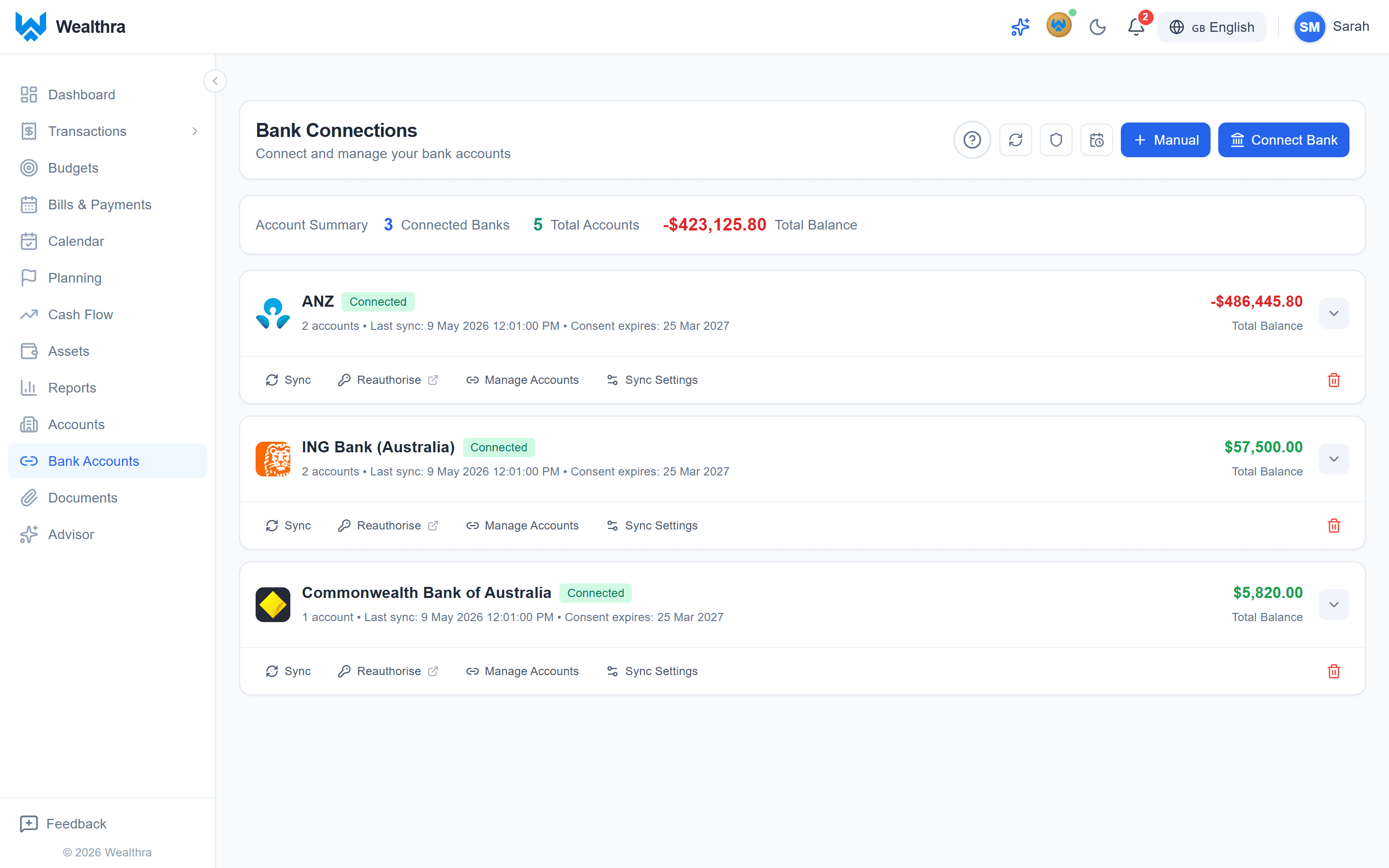
Many Australians want automated budgeting and a clearer net worth picture, but pause when an app asks to connect a bank. That hesitation is rational. The right question is not only “is this brand nice?” but “under which rules does this connection work, and what control do I keep?”
This guide explains Open Banking in Australia as it sits inside the Consumer Data Right (CDR): what it is, how consent works, how it differs from older screen-scraping, which institutions participate at a high level, and how consumer finance apps use the data. It is educational product content from Wealthra — not legal advice, not a security guarantee, and not personal financial advice.
What is Open Banking?
Open Banking is a regulated way for you to share selected banking data with organisations that are allowed to receive it under Australian law. In practice, that usually means balances, transactions and account details flowing through APIs after you complete a consent flow at your bank or data holder.
A useful mental model: you are not handing a stranger your house keys. You are granting a time-bounded, purpose-limited view of statements — and you can take that view away. For budgeting and net worth apps, the intended pattern is read-oriented access, not payment control.
Open Banking is the banking sector application of a wider policy: the Consumer Data Right. Official overviews are maintained by government and regulators, including the Consumer Data Right site, the ACCC CDR pages, and Treasury's CDR material. Always prefer those sources when rules change.
Open Banking vs the Consumer Data Right
People use “Open Banking” and “CDR” interchangeably in conversation. Technically:
- CDR is the legal and regulatory framework for consumer data portability across designated sectors.
- Open Banking is how that framework applies to banking data holders and the apps and services that request banking data with your consent.
The CDR regime has expanded over time beyond the first banking designations. Banking remains the part most relevant to personal finance apps that import transactions for budgets and cash flow. Product pages and consent screens should name the data clusters they request — read them before you approve.
A short timeline (high level)
Australia did not invent data portability overnight. At a high level, the public story looks like this:
- Policy design — successive reviews and Treasury-led design work established CDR as a consumer right with accreditation and privacy safeguards.
- Banking designation — major banks and then a wider set of data holders were brought into scope so consumers could share banking data through standardised APIs.
- Accreditation & representation — the ACCC accredits data recipients; smaller products may operate as CDR Representatives under an accredited principal rather than holding accreditation themselves.
- Ongoing expansion & refinement — rules, standards and participating institutions continue to evolve. Treat any static blog list as orientation, not the live register.
For institution-level detail relevant to connecting inside Wealthra, use Supported banks. For regime-level detail, use the official CDR and ACCC resources linked above.
How a connection actually works
A typical consumer journey looks like this:
- You start in the app — choose a bank or institution from the connection flow.
- You authenticate with the bank — login and multi-factor checks happen in the bank's environment. The app should not need your bank password.
- You set consent — accounts, data types and duration are presented so you can accept, adjust or cancel.
- Data flows over APIs — the accredited pathway delivers permitted data to the recipient (or representative arrangement) for the stated purpose.
- The app uses the data — for example categorising transactions, updating budgets, refreshing balances or net worth.
- You remain in control — consent can expire or be revoked; check both the app and your bank's CDR management tools.
Wealthra's product implementation of this flow is described on Open Banking features and security expectations on Security.
Consumer rights under the CDR framework
The CDR is designed around consumer control. In plain language, the practical rights people care about are:
You choose what to share
Select accounts and data types rather than handing over blanket access by default.
Read-oriented banking access
Consumer Open Banking connections are designed so apps can view data for services such as budgeting — not move money via CDR read APIs.
Time-limited consent
Consent does not run forever. Maximum durations are set in the CDR rules and products must support expiry and renewal flows.
Revoke any time
Withdraw access when your needs change. Deletion and retention obligations follow the CDR Privacy Safeguards and each provider’s disclosures.
Accreditation matters
Only accredited organisations, or CDR Representatives acting under an accredited principal, can receive CDR data lawfully in this model.
Exact obligations sit in legislation, rules and standards. If you need a definitive answer for a dispute or compliance question, rely on official guidance and qualified advice — not a blog summary.
Open Banking is not screen-scraping
Before CDR APIs were widely available, some tools asked for internet banking usernames and passwords and automated a browser-like session. That pattern is often called screen-scraping. It created a different risk profile: credential custody, session fragility, and broader access than a purpose-built API consent.
CDR Open Banking is built to replace that pattern for participating institutions. You prove your identity to the bank; the bank releases permitted data to an accredited pathway. When you compare apps, prefer clear CDR consent language over requests for your raw bank password.
Which institutions participate?
Participation has grown from the major banks into a much wider set of Australian banking data holders as obligations rolled out. That includes large retail banks and many smaller institutions — but “every product at every brand” is still the wrong assumption. Availability can differ by account type, brand subsidiary and connection partner.
Practical approach:
- Check Wealthra's supported banks list before you plan a migration.
- Confirm the exact institution name you bank with (brands and white-labels matter).
- Use official CDR directories and your bank's own CDR help pages when you need regime-level confirmation.
Which apps use Open Banking?
Categories of products that commonly request CDR banking data include:
- Budgeting and spend apps — import transactions, group merchants, track cash flow.
- Whole-of-position personal finance platforms — combine bank feeds with investments, super, property and goals (Wealthra sits here).
- Lending and comparison journeys — some credit or comparison flows use consented data to pre-fill or assess (different purpose statements than a pure budget app).
- Accounting and bookkeeping tools — business-oriented products may use related data-sharing patterns; consumer CDR banking is still the focus of this article.
Not every money app on the Australian App Store is a CDR participant. International products may rely on manual CSV upload, overseas aggregators, or no bank feed at all. When you evaluate alternatives, read the connection method in the product's own words. Our alternatives hub and 2026 personal finance app comparison discuss product fit without pretending every vendor uses identical rails. If you're coming from a closed app, see what happened to MoneyBrilliant users' data.
How Wealthra uses Open Banking
Wealthra Pty Ltd operates as a CDR Representative under Basiq Pty Ltd, an ACCC-accredited data recipient. That representative model is a standard way for products to deliver CDR connectivity under an accredited principal's arrangements.
In product terms, a Wealthra bank connection is meant to:
- Let you authorise directly with your bank through the consent experience
- Receive permitted account and transaction data over the accredited pathway
- Power categorisation, budgets, balances and net worth views inside Wealthra
Connected bank access is read-oriented for these feeds. Wealthra cannot move money from your bank accounts through CDR bank connections. For encryption, hosting and operational controls, see Security. For common product questions, see the FAQ.
Framework controls at a glance
Design goals of accredited CDR sharing — not a promise that every implementation is identical.
Accredited framework
Only ACCC-accredited data recipients and their authorised CDR Representatives can receive CDR banking data under the rules.
Read-only access patterns
For consumer banking use cases, connected apps typically receive balances and transactions — not payment initiation rights through CDR.
Credentials stay with your bank
You authenticate with your bank. Apps should not need your internet banking password.
Time-limited consent
Consent is time-bounded under the CDR rules (commonly up to 12 months) and can be managed or withdrawn.
Revoke when you want
You can withdraw consent through the app and often through your bank channels as well.
Government-regulated
Policy sits with Treasury; the ACCC enforces accreditation and compliance. Always check current official guidance.
How to evaluate whether a connection is right for you
Before you connect any finance app — Wealthra included — work through a short checklist:
- Who receives the data? Accredited recipient name, and whether the product is a CDR Representative under a principal.
- What data clusters are requested? Accounts, transactions, balance, payees — only approve what the product needs.
- What is the purpose? Budgeting and net worth are different from credit assessment. Purpose statements should match the product you think you installed.
- How long does consent last? Note expiry and renewal reminders.
- How do you revoke? In-app path and bank-side CDR management options.
- Where is the privacy policy? Retention, overseas disclosure, and deletion commitments should be readable in plain language.
That process will not eliminate every risk online. It does align your decision with how the Australian framework expects consumer sharing to work.
Frequently asked questions
What is Open Banking in Australia?
Open Banking is the banking implementation of the Consumer Data Right. With your consent, selected banking data can be shared through regulated APIs with accredited recipients or their authorised CDR Representatives — without giving those apps your bank password.
Is Open Banking safe?
The regime is built around accreditation, consent, purpose limitation and consumer control. That is a stronger design than handing an app your internet banking password. It is still not a blanket guarantee that every product, device or human process is perfect. Read disclosures, use strong device security, and revoke access you no longer need.
Can an Open Banking app drain my bank account?
Consumer budgeting connections are designed around reading permitted data, not initiating payments through CDR read APIs. That is different from granting someone full internet banking control. Always read the permissions on the consent screen for the specific product.
Is screen-scraping the same thing?
No. Screen-scraping generally means sharing login credentials so software can imitate a banking session. CDR Open Banking is an API-and-consent model under accreditation rules.
Which banks support it?
Major banks and many other Australian institutions participate, with coverage expanding over time. For Wealthra specifically, start with supported banks. For the broader regime, use official CDR resources.
Does connecting cost anything at the bank?
Under the CDR framework, data holders provide required consumer data sharing under the rules rather than charging consumers a separate “CDR fee” for standard sharing. Apps may still charge for their own software plans. Wealthra includes bank connections on paid plans — see Pricing.
What if I change my mind?
Revoke the connection in the app (in Wealthra: Settings → Bank Connections) and review any bank-side CDR authorisation tools your institution provides. Ask the provider how deletion and retention work after revocation — those details belong in their CDR and privacy disclosures.
Official references
Disclaimer. This article explains the Australian Open Banking / CDR framework in general terms for education. It is not legal, security, or personal financial advice. Rules and participation lists change — verify critical details on official sites and in each product's current disclosures.
Related reading
Category-by-category comparison of budgeting, portfolio and Open Banking tools.
Wealthra Open BankingHow bank feeds work inside the product after you consent.
SecurityControls and practices behind Wealthra accounts and data.
Supported banksInstitutions available for connection in Wealthra.
Want bank feeds under CDR rules?
Explore Wealthra free, or start a paid plan trial when you are ready to connect Australian accounts through Open Banking.
Get started